

© 2026 Robert Sickles
In my previous story, Pat and Mikie, I wrote about my time being bullied by some older boys at the Rockaway River beach and along the old Morris Canal towpath in my hometown, Denville, NJ. Since a vestige of it was right in my neighborhood, the Morris Canal always interested me. But only recently did I begin to learn more about it, including one particular event—Denville’s darkest secret.
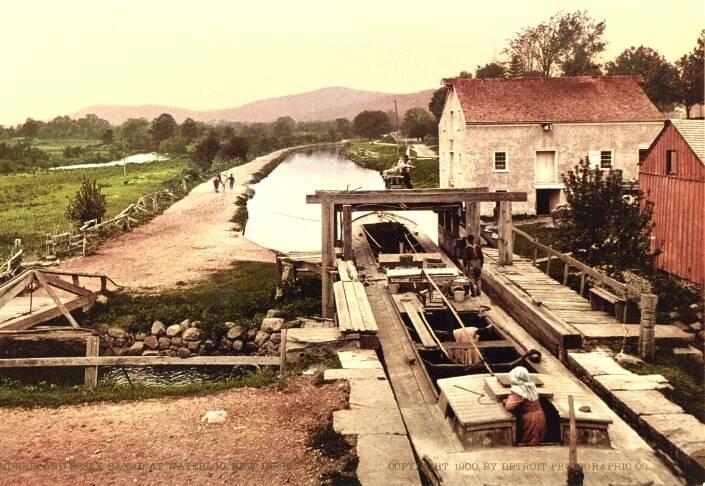
Lock 3 West, The Morris Canal at Waterloo, NJ, around 1900
First, the boring facts: Before the early 1830’s, Pennsylvania coal was carried to a port on the Delaware River, loaded on ships that carried it around the southern tip of New Jersey and up the Atlantic coast to New York and other nearby cities. The idea of putting in a 107-mile canal across New Jersey with its numerous ridges of hills must have been a preposterous idea to many, but a complex array of locks, aqueducts and water-powered lifting mechanisms was built to climb up and down the 900’ elevation change and became the regions’ first large-scale transport system for industry. Grain, commodities, ice, ores and minerals were also carried on both east and westbound trips. Even some passengers found the canal an enjoyable way to travel.
A few Denville businesses served the crews that stopped over at the locks. I knew of an old building, once a grocery store, that still stands close to traces of the canal there. The town was also known for aqueducts that carried barges over the Rockaway River. But In 1924 the legislature ordered the canal to be drained and filled in because railroads made mule-drawn barges obsolete. Within 5 years, the canal was all closed down.
Today, only short segments of the canal and a few locks are preserved in parks and places like historic Waterloo Village. As I wrote before, the old overgrown towpath could still be found in the woods that I explored in my boyhood. While there may not be much of it left in Denville to see now, there are plans to create trails along a greenbelt that would follow much of the original canal route.
So, then I learned about the murder on the old canal towpath, committed two years before we moved into the house near the old canal towpath. It seems very few people still alive knew about it until a book came out 5 years ago that told the forgotten story. The Denville 13, by Peter Zablocki, is about the 1953 murder of a sex offender involving a group of 13 boys between ages of 14 and 22. (Note: it's unlikely there is any connection between these boys and the ones that picked on me in the same location 5 years later!)
The victim was known to be a convicted predator who had served time for taking indecent liberties with young boys. He was lured to the spot by youths who intended to rough him up and drive him out of town. But several more boys joined in and, as things escalated, they wound up beating him to death. The scene of the crime was left to appear as a robbery gone wrong. Even though some of the boys weren’t really involved in the beating, the police investigation led to 13 arrests, triggering the largest murder indictment in U.S. history to this day. Guilty pleas to lesser charges allowed the judge to skip trials and grant several younger boys probation or referral to juvenile authorites. Only the oldest one was sent to prison.
On one hand, the story broke with sensational reporting in front-page news. Incredibly, I found a digital copy of a 1953 issue of The New York Times that listed the names, ages, and addresses of all 13 boys, before they’d even been sentenced! The press didn’t mind exposing the identities of juveniles accused of crime in those days. I guess that's legal, but is generally withheld now.
Afterwards, on the other hand, the proclivities of the deceased and the events of the murder resulted in the most thorough whitewashing, including buried police and court records and missing newspaper reports. Up against the good old spirit of “it’s best not to talk of such things,” Mr. Zablocki encountered intense coverup and repressed memories when researching for his book. It's quite a story, and a well-written book.
I asked my brother, eleven years older, if he’d ever heard about the Denville 13, and he matter-of-factly said, “Oh yeah, that murder? Of course, I knew some of those kids from high school, and I knew about that guy they killed.” The crime certainly wasn’t something discussed at our dinner table, nor was there even a little caution about me playing in those woods. Things are changing in these times of disclosures!
Bloody hell, I’m just a little creeped out.
Add comment
Comments
Interesting in the least...good.
that is a bit creepy!
Tow path justice, New Jersey style
What a tantalizing piece of local history. I wish I had known more and been more interested back in 1965 when I began exploring the backwoods and streams around Denville. I remember where Peer's store was; wonder if it's still there. Thanks, Bob!