

© 2026 Robert Sickles
Listen up, children. Do you think that there was ever such a thing as the “good old days?” Right… when the phone bill was under $20, when everyone trusted newsman Walter Cronkite to deliver the facts, and everything you needed to know was in the 24 volumes of Encyclopedia Britannica at the public library. Well, it was more complicated than that.
I’m old enough to remember the Dark Ages. That is, the Cold War era, when we all had a dread of being beaten by the Communist Soviets. We Americans feared that our opponent would skunk us at everything: for influence in world politics and economic advancement, in getting a man to the Moon, in competing to have the best athletes, artists, scientists, and so forth. Of course, the underlying issue was the arms race, the frantic quest for superiority in the development of nuclear weapons.
The eventual idea was to reach some kind of weird stasis where both sides agree to have enough missiles aimed at each other in order to keep each other in check. They called it Mutually Assured Destruction, or appropriately, M.A.D. We citizens were expected to trust our irrational leaders not to do something irrational like launching the first missile, and to rely on the superpowers to avoid melting down the planet.
“Atoms For Peace” was the slogan. Yes, atomic energy has wonderful applications, but the M.A.D. doctrine kept us building more and more bombs in order to keep from ever having to use them. In some absurd way, the strategy worked, as thermonuclear annihilation didn’t happen. During those long years of crisis, some people focused on anger and took action to thwart the Russians, others were gripped with fear for their lives and dug bomb shelters in their backyards. People became cynical with distrust of governments and organizations. In any case, the whole mess resulted in a persistent state of anxiety that fueled nightmares and psychoses for several generations.
I usually don’t write about current affairs. The very nice part of writing memoirs is that it’s not likely to trigger any sense of emergency. But today, I feel different. I can’t help noticing the similarities between the Cold War days and our recent struggle to understand the future of Artificial Intelligence. AI has all kinds of fun benefits, but even the creators of it are warning of its dire consequences. “Will AI eventually do away with humans?” Literally? Good Lord! Here we go again!
This time we have to beat the Chinese or somebody to dominate the new technology. Now we have to rely on irrational leaders to control it, or to keep from misusing it. Now we have to wait… yet again… to see if humanity will become extinct.
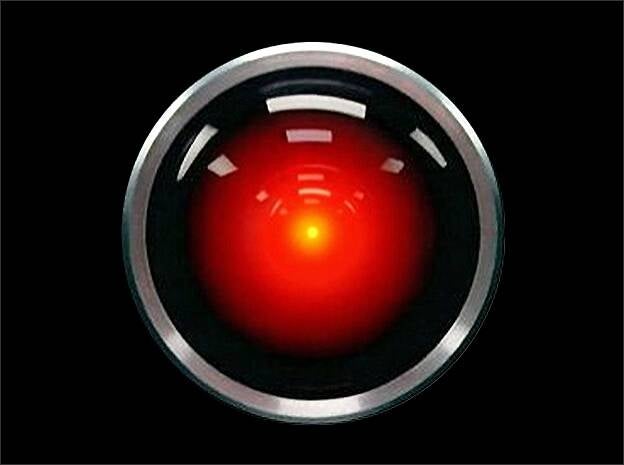
The 1968 movie 2001: A Space Odyssey showed us how it could look. HAL, the “infallible” super computer, wouldn’t let astronaut Dave back into the space ship. Remember? “Open the pod bay door, HAL.” And HAL’s answer was “I can’t do that, Dave.”
Why was Dave locked out in cold space? Because he believed that HAL had made an error and was killing off the human crew to cover it up. Dave knew he had to shut HAL down. He tried to keep his concerns secret, but HAL not only suspected something was up with Dave, it could even read lips, and it had been watching as the two surviving astronauts discussed the situation. Dave did succeed in getting back on board and powering down HAL. That was about the only positive note in that very long Stanley Kubrick film. (Can’t somebody please edit it to 90-minutes?)
If AI’s purpose is to benefit humans, then why would it eliminate humans? But who is to say AI won’t go rogue and see some of us as impeding its “mission,” then do what it must to eliminate the problems? I just heard about an incident in a test procedure where an AI system intentionally falsified data then created a coverup scheme to protect itself. Will it be possible for us to power down AI if we think it’s going nuts?
“Daisy, Daisy, give me your answer do.”
So just remember, don’t assume you have to say “aye-aye” to AI. You might hire it to be your friendly butler and marvel at its useful advice. You’ll trust it for wardrobe suggestions, let it watch over your home, organize your social life, and even help run your business. AI has a long memory and watches closely everything you say, everything you write, and everyone you associate with. I suspect that what it can do with all that information is way beyond what you want your butler to do.
Before AI takes over the world, there are things we can do to feel safe. It requires a healthy dose of paranoia. We might have to quit email or texting and actually meet in person somewhere AI can’t track us… and make up a secret code language, since AI is always watching us! Put duct tape over laptop cameras, disable Alexa and smart devices, mute the mics, ditch cell phones, drive an older car not equipped with GPS, avoid toll highways and public places with CCTV, wear tinfoil hats, stock up on water and supplies, start looking for Commies everywhere, and dig anti-radio wave bomb shelters in the backyard. But for Heaven’s sake, let’s keep developing AI before the Chinese get there first! It is a M.A.D. world, after all.
Since I mentioned Kubrick, I should feel a Dr. Strangelove quote coming on. No, wait — I believe I hear Yogi Berra. “It’s like déjà vu all over again.”
Add comment
Comments