

© 2026 Robert Sickles
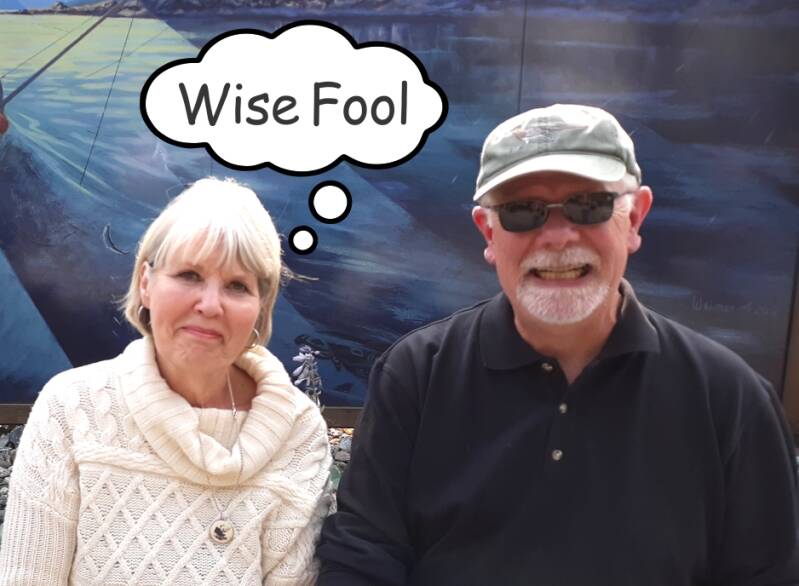
When deciding if we could drive down to the lake for our morning walk, Linda asked me if it is raining or not. I didn’t bother to look out the window or check the weather report, and simply replied, “Yes.”
“Yes which? I need to know if it’s raining or not? Are you being a smart aleck again?”
I thought it was time for a lesson in logic, “My Dear, you asked if it is raining or not. Both could be true, so the answer to your question is always “Yes. It is or isn’t raining.”
Not in the mood, Linda turned back to pawing through her closet. “So frustrating… for pity’s sake, just tell me if I should wear a rain jacket or not!” This time, I held my tongue.
Yes, ladies, gentlemen, and others, I am a difficult person to communicate with at times. Like any word-nerd, I dabble in semantics, figures of speech, and word origins to the extent that it flows over into normal conversation, however tiring I become to others. I think I used to dislike those people who enjoyed making a point about my grammar while I was in the middle of a sentence. Now I am one of those people. NOTE: I hereby disclaim any educated knowledge of this subject; I use and misuse grammar ad lib. It has already been established that I make up what I don’t feel like researching. Any comments or complaints about my grammar will be referred to our AI customer support team.
The above business about rain is an example of logic tautology, which is often an “either/or” statement, where both ends can be true. When you say, “I’m either going to get a job or I’m not,” it sounds like a time for congratulations! But you really aren’t standing firmly on a yes or no decision. If asked if I’d prefer soup or salad with my entree, I say Yes. And I do get some perturbed looks from waiters.
Another way of defining tautology is the use of redundant words, such as the phrase “Free Gift,” where free is implied with the word gift. Others examples: “Evening Sunset,” “True Fact,” “Close Proximity,” and “Future Predictions.” Sometimes these everyday expressions stand out as ridiculous if you think about them too much! When someone overuses tautology, you get sentences like “I need you to write a short summary and have it on my desk by 6 a.m. in the morning.” Also, when people say things like “boys will be boys” or “it’s over when it’s over,” they should be tickled to know they are tautologists!
A tautology could be considered the opposite of an oxymoron—you know, like “Jumbo Shrimp,” “A Definite Maybe,” or “An Open Secret.” Oxymorons are pairs of opposites, a creative way of expressing irony, or even a silly pairing of words. “Military Intelligence” is one of my favorites of that sort. Lots of oxymorons are used every day, such as “Civil War,” “Negative Growth,” “Working Vacation.” The word sophomore means “wise fool,” which would be the way Greeks made fun of 2nd year scholars.
Understanding and creating funny little names for these figures of speech must have been a passion for some thinkers ages ago. For example, there is no reason anyone should need to know the difference between a metonym and a synecdoche, but here I am to explain it to you anyway. When you say “The White House” to refer to the seat of Executive Power, or “Hollywood” to mean the film industry, you are using metonymy. They are short concepts that refer to a larger whole. More examples: “Top Brass” = military officers; “Red Tape” = cumbersome bureaucracy; “Wall Street” = American financial center; “The Press” = the news media; “The Middle East” = everywhere between Turkey and Pakistan.
A bit different, a synecdoche is where a component of something refers to the whole, as when referring to your car as “Wheels,” or your clothes as “Threads.” More examples: “Boots” = soldiers; “Hands” = workers; “Lead” = ammunition; “Plastic” = credit cards. And again, when we say things like “Lend me your ears,” and “Count heads.” A brand name can become a synecdoche for similar products: Kleenex, Band-Aid, Coke, Xerox, Muzak.
I have a tip to pass on: You might think, as I have, that dazzling people with your awareness of the synecdoche would make for good party conversation. Face it, unless you are surrounded by a jolly mob of inebriated grammarians, it doesn’t.
There are a few more figures of speech I could talk about. If anyone is still reading, I'll count heads to know if should continue blathering. Actually, I’m tired of thinking about this useless stuff! Thanks for lending me your ears.
Add comment
Comments
If a first you don't succeed, skydiving is not for you.
Your piece was much needed to put a smile on my face after yesterday's horror in Bend OR. My traveling friends live there. I can't begin to imagine their sorrow.